

Introduction
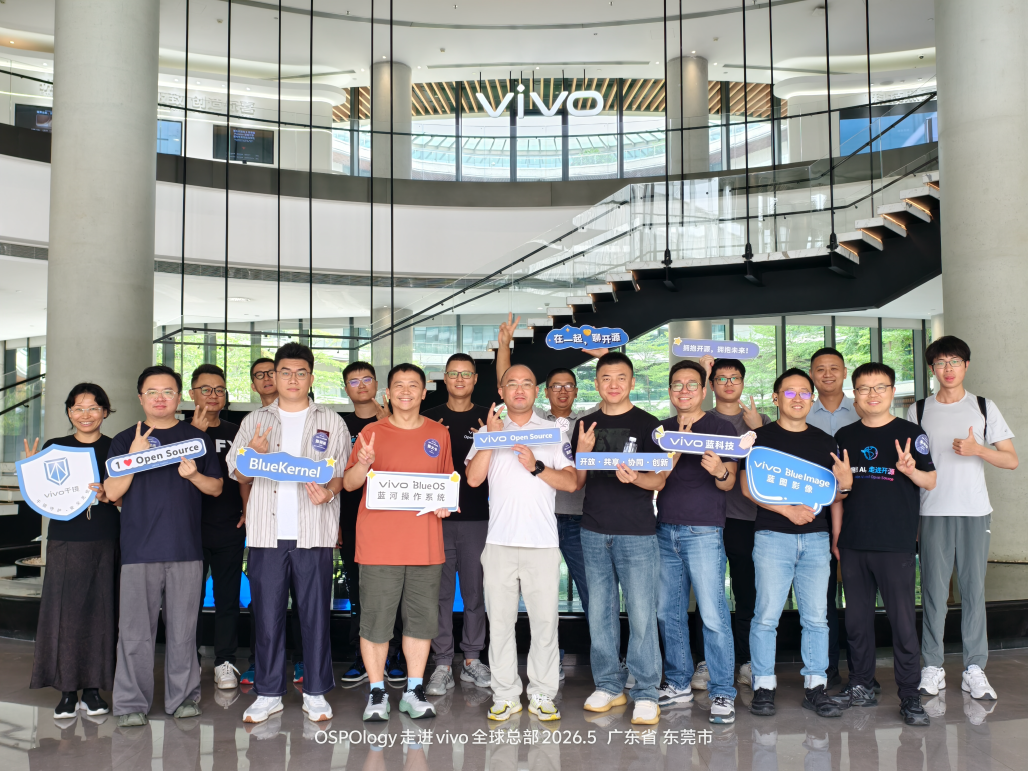
The OSPOlogy arrived at the vivo Industrial Park and Global Headquarters in Chang’an, Dongguan city, Guangdong Province On May 15, 2026. Co-hosted by vivo Open Source and the TODO Group ambassador, this open source event brought together open source experts from the Linux Foundation APAC, LFOSSA, OpenChain, ByteDance, Huawei, ZTE, OpenAtom Foundation, and other organizations.
Event Agenda
Date & Time: May 15, 2026 — 10:00 - 17:00
Venue: vivo Industrial Park & vivo Global Headquarters in Chang’an, Dongguan, Guangdong Province.
Agenda
1、vivo Campus Tour
- 9:50 – 10:00 — Welcome remarks from vivo Open Source — Chris YANG, vivo Open Source
- 10:00 – 11:00 — Experience vivo: STM Production Line & Quality Lab | vivo Industrial Park
- 11:00 – 14:00 — Lunch & Break
- 14:00 – 14:30 — Discover vivo: Corporate Culture Exhibition Hall | vivo Global Headquarters
2、Open Source Discussions | vivo Global Headquarters
Part A: 14:50 – 16:30 — Keynote Presentations
- Exploring OSPO Positioning and Functions in the Agentic AI Era — Hin YANG, LF APAC
- AOSP Open Source Governance Practices — Tao Ye, Grandall Law Firm
- Insights on Open Source AI Supply Chain and Software Supply Chain — Liu Jinming, vivo Open Source
- Transformation and Entanglement: Exploring the Essence of Enterprises and Open Source in the Agentic Era — Jason LI, Founder of the The Tao of Open Source Community, TODO Group Ambassador
- vivo BlueOS, BlueKernel and hapjs Open Source Projects Sharing — Wang Bin, vivo Open Source
Part B: 16:30 – 17:00 — Lakeside Walk · Open Source Conversations
- Free Discussion
Highlights and Key Discussions
1.vivo Campus Tour
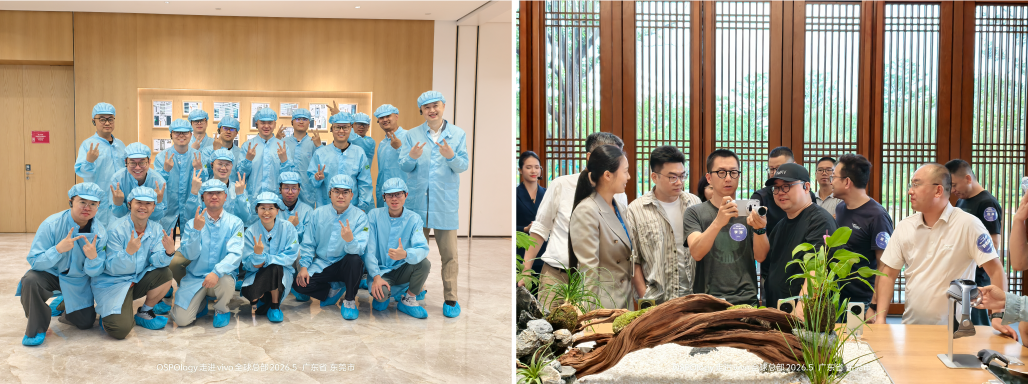
During the “vivo Campus Tour”, a guided tour of the STM Production Line, Quality Laboratory, and Corporate Culture Exhibition Hall allowed participants to experience vivo’s uncompromising pursuit of excellence, while gaining deep insights into its technological prowess and development milestones.
2. Keynote Presentations: Exploring Open Source in the AI Era
① Exploring OSPO Positioning and Functions in the Agentic AI Era
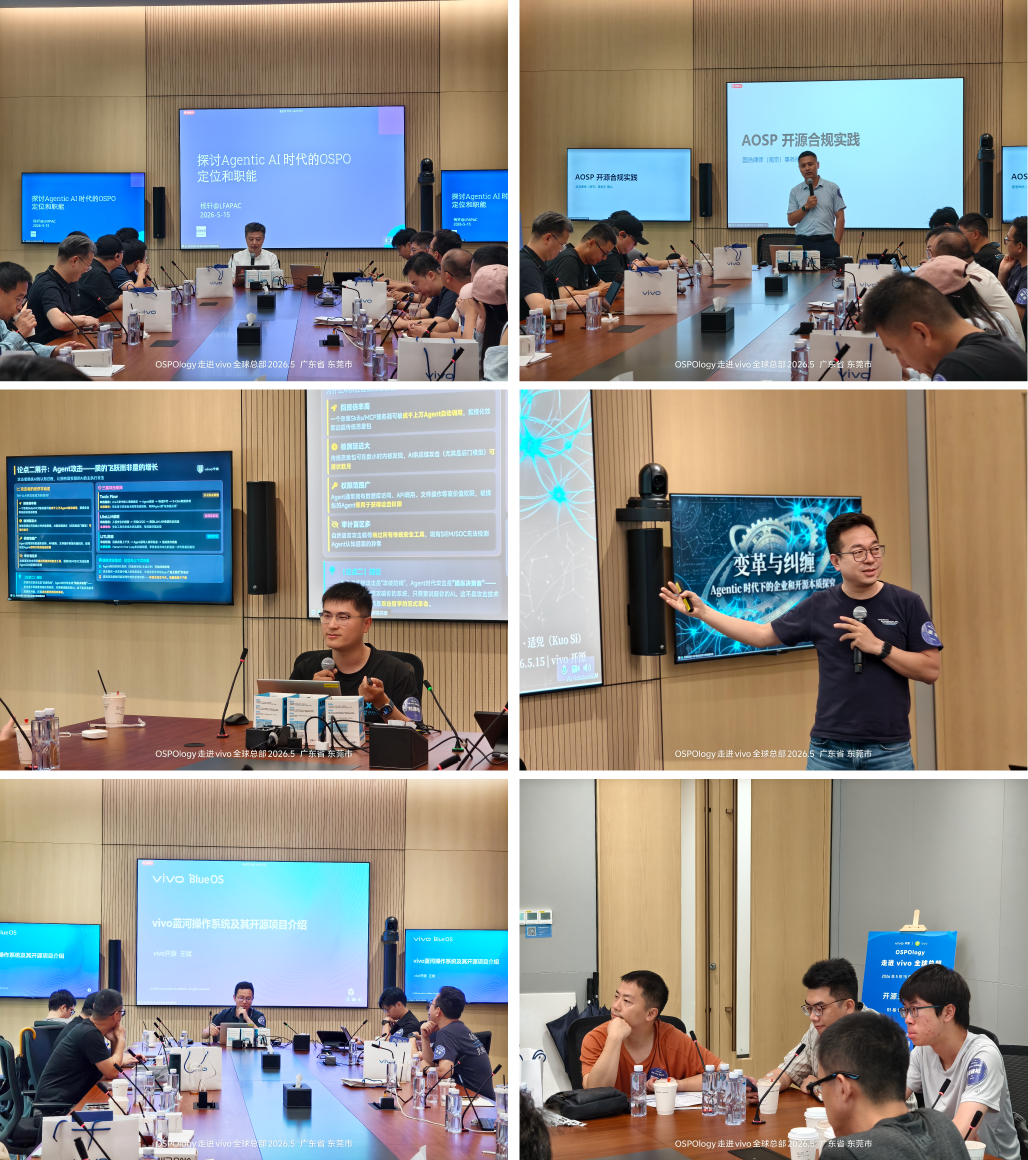
Hin Yang from LF APAC delivered a keynote on “Exploring OSPO Positioning and Functions in the Agentic AI Era,” discussing that in the Agentic AI era, the Open Source Program Office (OSPO) must upgrade from a traditional “open source compliance office” to a “hub for open technology governance.” The future OSPO will no longer be limited to software compliance, but will extend its governance paradigm to AI governance, Agent governance, supply chain security, and ecosystem strategy.
② AOSP Open Source Governance Practices
Tao Ye, Partner at Grandall Law Firm, shared “AOSP Open Source Governance Practices.” He analyzed the NOTICE, SBOM, and compliance metadata generation mechanisms of AOSP 16, pointing out potential compliance risks such as NOTICE information loss, failure of SBOM to automatically aggregate static dependencies, and “ghost modules.” To address these issues, he recommended standardizing the configuration of Android.bp, accurately injecting SPDX identifiers and license texts, and adhering to unified builds using standard Soong commands.
③ Insights on Open Source AI Supply Chain and Software Supply Chain
Liu Jinming from vivo Open Source analyzed the profound changes in software supply chain security in the AI era regarding attack surfaces, attack vectors, and governance granularity, and introduced vivo Open Source’s related practices. His core viewpoint is that enterprise OSPOs need to establish new AI-oriented visibility tools, governance languages, and trust models to better understand and manage AI behaviors, as visibility is the prerequisite for security governance.
④ Transformation and Entanglement: Exploring the Essence of Enterprises and Open Source in the Agentic Era
In the keynote “Transformation and Entanglement: Exploring the Essence of Enterprises and Open Source in the Agentic Era,” Jason LI, TODO Group Ambassador, Founder of the The Tao of Open Source Community, noted that from the perspectives of complex systems and new institutional economics, open source collaboration is moving from “sharing code” to “sharing reasoning pathways”—a leap from human-to-human collaboration to human-to- AI Agent collaboration. Accordingly, the strategic positioning of the OSPO needs to be upgraded to “the ultimate diplomatic hub bridging human-machine systems,” responsible for coordinating protocols, intents, and communications, and aligning engineers, the Agentic market, and enterprise goals.
⑤ vivo BlueOS, BlueKernel and hapjs Open Source Projects Sharing
Wang Bin from vivo Open Source introduced the open source strategy of vivo BlueOS. At the system level, BlueKernel, vivo’s self-developed operating system kernel based on the Rust language, has been officially open-sourced and contributed to the OpenAtom Foundation for incubation. At the application level, vivo continues to actively contribute to the hapjs open source project, which recently open-sourced the lightweight card engine source code for building smart services.
3. Lakeside Walk · Open Source Conversations
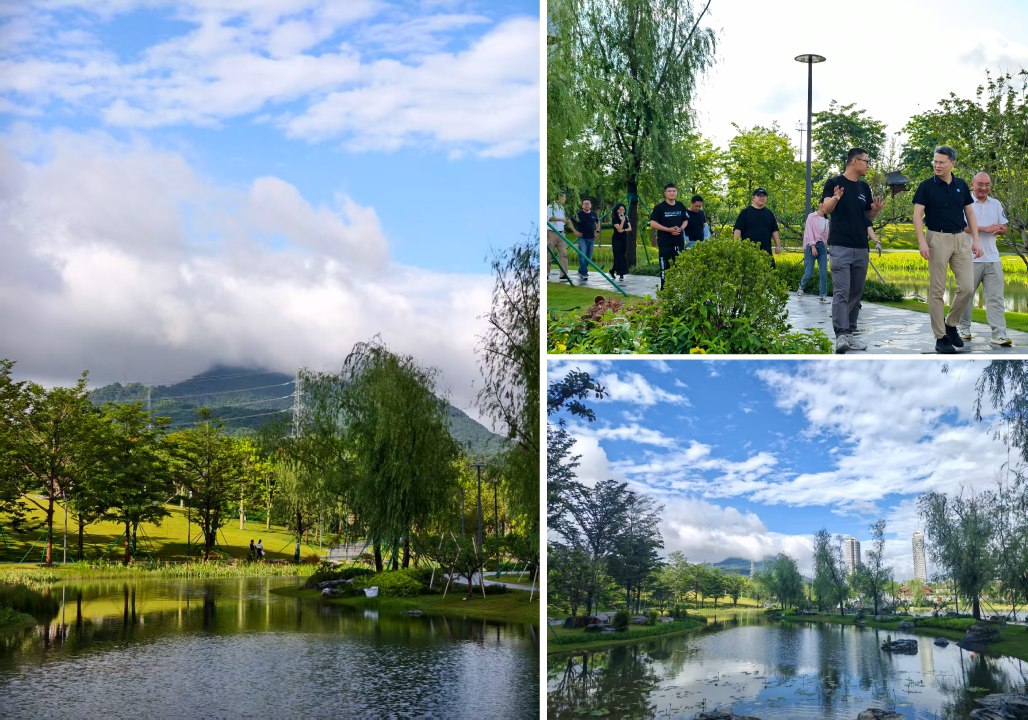
For the free discussion session, participants moved to the Lotus Lake at vivo Global Headquarters. Amidst the beautiful lake and mountain scenery, they strolled and conversed, extending the insightful discussions from the meeting into relaxed and joyful open source chats. In the breeze and greenery after the rain, they freely discussed the open source ecosystem.
Wrap Up
The event, proudly co-initiated by vivo Open Source and the TODO Group Ambassador, has come to a successful close. We would like to extend our deepest gratitude to our speakers for their insightful sharing, our attendees for their active engagement, and our partners for their incredible support.
As we step into the era of Agentic AI, we are working together to explore the evolving responsibilities and the new positioning of enterprise OSPOs. Our focus is expanding beyond traditional software source code to encompass open-source large models and open datasets, paying close attention to the entire supply chain of the software and AI ecosystems.
Moving forward, we hope to foster broader collaboration through active dialogue, jointly navigating industry challenges and seizing new opportunities. By elevating OSPOs from day-to-day operations to strategic drivers of healthy business growth, we ultimately aim to build a sustainable and thriving open-source ecosystem.
Embrace open source, embrace the future!
NOTES: Keynote Presentations Download
Special thanks to vivo and TODO Group ambassador for hosting, and to all participants for their contributions to open source collaboration in China.